Last reviewed November 2026. Soil data queried November 2026.
Temecula soil and concrete: what the survey shows
The USDA's Natural Resources Conservation Service maps soil across the whole country in a database called SSURGO, the one behind Web Soil Survey. To see what sits under Temecula's driveways and patios, we laid a grid of points about 1.1 kilometers apart inside the Census Bureau's city boundary, 78 in all, took the main soil at each one, and read two ratings that matter for concrete. The results matter for a concrete slab in Temecula, which rests directly on that ground, and for every other job on the concrete contractor in Temecula CA page.
- Linear extensibility: how much the soil changes in length between moist and oven dry, in percent. The more clay, the bigger the number and the harder the ground pushes and drops under a slab through wet and dry seasons.
- Corrosion of concrete: the survey's low, moderate or high risk that the soil chemically weakens concrete, based mainly on sulfate and sodium content, texture, moisture and acidity.
| Soil | Points | Linear extensibility (max, top 60 cm) | Corrosion of concrete | Drainage |
|---|---|---|---|---|
| Ramona loam and sandy loam | 16 | 1.5% | Low | Well drained |
| Arlington fine sandy loam | 10 | 1.5% | Low | Well drained |
| Hanford coarse sandy loam | 9 | 1.2% | Low | Well drained |
| Rough broken land, rockland, gullied land | 15 | not rated | not rated | Steep and rocky |
| Grangeville fine sandy loam | 5 | 1.5% | Low; high on the saline-alkali phase | Moderately well to poorly drained |
| Las Posas rocky loam | 4 | 7.5% | Low | Well drained |
| Greenfield sandy loam | 4 | 1.5% | Low | Well drained |
| Cieneba rocky sandy loam | 3 | 1.5% | Moderate | Somewhat excessively drained |
| Visalia fine sandy loam | 3 | 1.5% | Low | Somewhat poorly drained |
| Chino silt loam, saline-alkali | 2 | 4.5% | High | Somewhat poorly drained |
| Lodo, Fallbrook, Cajalco | 4 | 4.5% | Low | Well to somewhat excessively drained |
| Porterville clay, Placentia fine sandy loam | 2 | 7.5% | Low to moderate | Well to moderately well drained |
| Riverwash | 1 | 0% | not rated | Excessively drained |
Swipe sideways to see every column.
USDA NRCS SSURGO via Soil Data Access, main component at each point, queried November 2026. A soil survey maps at the scale of a neighborhood, not a single lot.
Where Temecula's difficult ground is
Clay in the southern hills
The soils that move most turned up on the city's southwest edge. Four points there fell on Las Posas rocky loam, with up to 40 percent clay and a linear extensibility of 7.5 percent, and one on Porterville clay at the same 7.5 percent with up to 50 percent clay. A Placentia fine sandy loam on a hillside just south of Old Town read the same. Ramona and Arlington, the two most common soils in the sample, read 1.5. Ground at 7.5 swells with winter rain and shrinks through a long dry summer, so a slab on it can be lifted and dropped from one season to the next.
Salty silt along Interstate 15
Three points between Rancho California Road and Winchester Road, close to the freeway, fell on Chino silt loam and Grangeville fine sandy loam mapped as saline-alkali, and all three rated high for corrosion of concrete. The USDA ties that rating mainly to sulfate and sodium, and notes that concrete crossing from one soil layer into another is more exposed than concrete sitting in a single soil. The City's own driveway drawing plans for ground like this.
Rocky slopes
About one point in five fell on rough broken land, rockland or gullied land, which the survey doesn't rate for either property. Those points are mostly steep slopes and open space; on a hillside lot that was graded for a tract, the original grading report says more about the ground than the soil map can.
What changes in the build
| Ground | What it does | How the slab is built for it |
|---|---|---|
| Sandy loam (Ramona, Arlington, Hanford) | Drains fast and barely moves | Compacted base, normal joint spacing, standard 4 in slab |
| Clay (Las Posas, Porterville, Placentia) | Swells when wet, shrinks when dry | Deeper compacted base, steel at mid-depth, closer joints, water kept off the edges |
| Saline-alkali silt near I-15 | High sulfate and sodium risk | 6 mil plastic sheeting under the slab, as Standard No. 207 asks for an approach |
| Fill on a graded slope | Can settle or creep | Check the grading report; keep slabs back from the top of the slope |
Ground behavior from the USDA SSURGO definitions of linear extensibility and corrosion of concrete; sheeting from City of Temecula Standard No. 207, note 4; slope note from Wolf Creek Design Guidelines, Exhibit B (2011).
The City's Standard No. 207 is direct about the salty ground: its note 4 says to use 6 mil plastic sheeting when the abutting soil has a high sulfate content, and the drawing extends that sheeting 2 feet past the concrete. That rule is written for the driveway approach, but a driveway or slab on the same soil faces the same chemistry. The drawing also has the top 12 inches of subgrade compacted to 95 percent, a good habit on any soil.
Wine country, De Luz and Rainbow
Outside the city the picture is mostly good news. Spot checks on Rancho California Road, Anza Road at Pauba Road and Los Caballos Road came back as Hanford sandy loams with a linear extensibility of 1.1 to 1.2 percent and a low corrosion rating, and the eastern end of Rancho California Road as Ramona. The De Portola Road and Glen Oak Hills points fell on rough and gullied land. West of the city, De Luz Road and Sandia Creek Drive sit on Fallbrook sandy loams at 4.5 percent, and in Rainbow the valley floor is Placentia sandy loam at 7.2 percent with up to 43 percent clay and a moderate corrosion rating, the most clay-rich reading of any spot we checked outside the city. More on building out there is on the wine country page.
Cracks that the soil causes, and cracks it doesn't
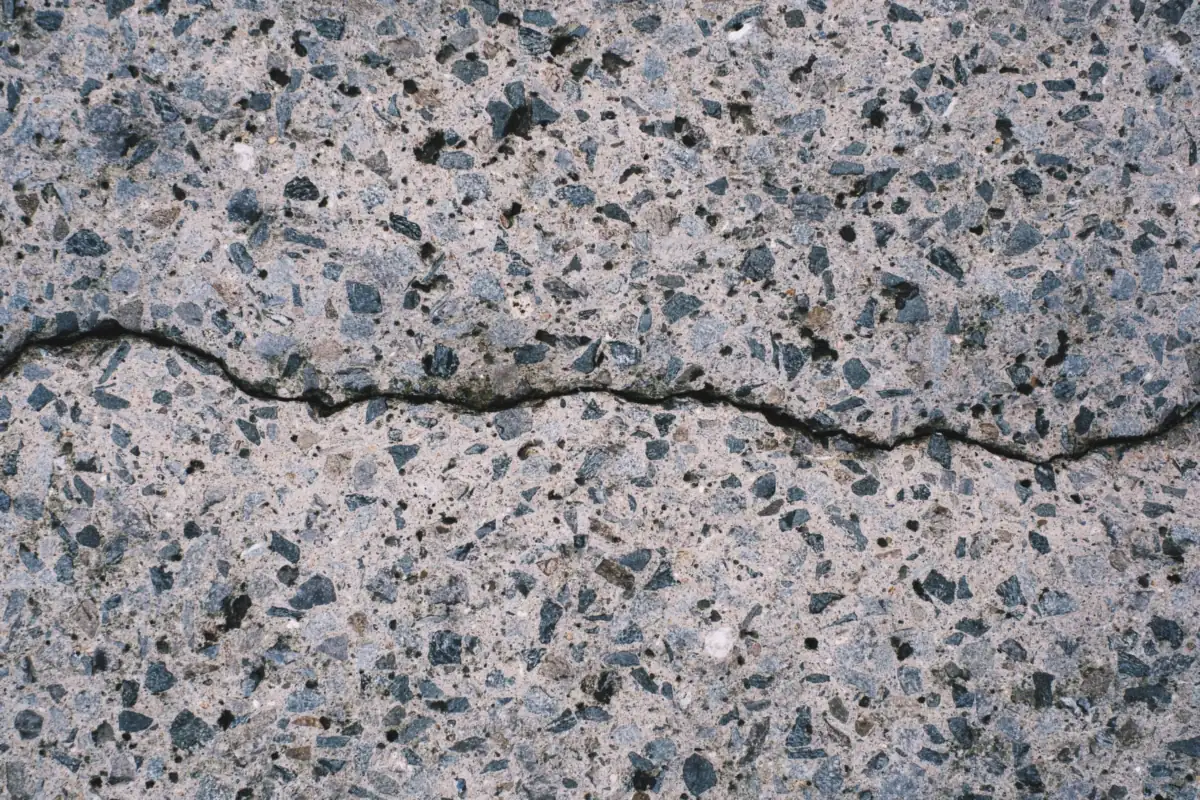
Not every crack is the ground's fault. A thin crack across a panel is usually shrinkage, which every slab does as it dries, and the control joints are there to catch it. Soil movement shows differently: a panel that has tilted, a corner that has dropped, an edge lifted above its neighbor, or a crack that keeps widening after a wet winter. Wolf Creek's design guidelines put it plainly for owners there: soil-related cracking of most exterior slabs is generally cosmetic, while cracking in a pool or spa is not, which is why pools there are designed with a geotechnical engineer.
Water makes clay worse, so on any soil the cheapest protection is grading. The California Residential Code wants impervious surfaces within 10 feet of the house to fall at least 2 percent away from it, and sprinklers aimed at the slab edge undo that. Summer pours bring their own cracking, covered in the hot weather guide.